Book Appointment Now


The Biggest Challenges Faced by Daily-Wage Construction Workers in India
Every morning, before most of India wakes up, groups of men and women gather at labour chowks, junctions, and contractor offices across the country’s cities and towns. Some will find work by 8 a.m. Others will still be standing there at noon, and will walk home with nothing. This is not a rare occurrence. It is a daily routine for a large share of India’s construction workforce — the people who lay foundations, pour concrete, wire buildings, and finish the homes and offices the rest of the country lives and works in.
India’s construction sector is one of the largest employers in the country. According to National Sample Survey data https://www.mospi.gov.in/national-sample-survey-office, the sector employs more than 74 million people — more than manufacturing — making it the second-largest source of non-agricultural employment in India, after agriculture itself. The Ministry of Labour and Employment has separately estimated the number of construction workers at around 5 crore (50 million). Yet a large share of daily wage construction workers in India work without written contracts, consistent wages, or access to the welfare schemes designed specifically for them.
This is the contradiction at the heart of India’s construction story. The country is building metro lines, highways, housing colonies and business districts at a pace few nations can match. But many of the workers responsible for that growth still cannot answer a simple question with certainty: will there be work tomorrow?The challenges faced by construction workers in India are not limited to finding employment. Workers also face uncertainty around wages, safety, migration, social security and career progression.
So what are The challenges faced by construction workers in India, and why do they persist despite decades of policy attention? This article looks closely at the real, documented problems faced by construction workers in India — from irregular employment and wage uncertainty to safety risks and the difficulty of getting matched with the right job. It also looks at where technology, including platforms like Digital Labour Chowk, fits into the solution, and where it does not.
1. Irregular Employment and Uncertainty About the Next Job
Construction work in India is largely project-based. A worker is hired for the duration of a specific phase of a project — laying a foundation, finishing brickwork, plastering — and once that phase ends, the job ends with it. There is no guarantee of continuous employment on the next site.
This creates a cycle familiar to most daily-wage workers: a period of steady work followed by an unpredictable gap before the next one begins. Work availability also shifts with the seasons. Monsoon months typically slow down outdoor construction activity in large parts of the country, while festival seasons can bring temporary halts as workers travel home and projects pause.
Understanding the Challenges Faced by Construction Workers in India,For a household that depends on daily earnings to cover rent, food, school fees and healthcare, this irregularity is not a minor inconvenience — it is a constant source of financial stress. Unlike salaried employment, there is no buffer, no leave pay, and often no advance notice before work runs out.
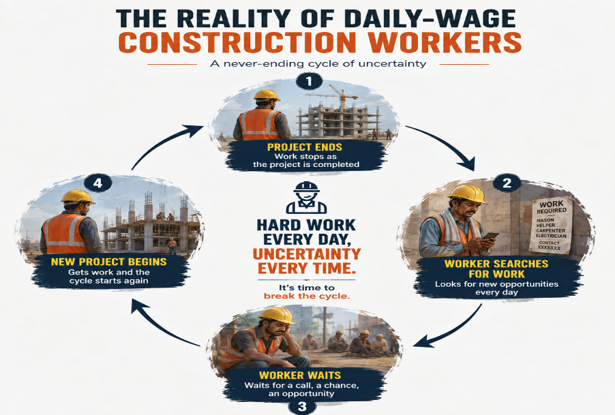
Project ends → Worker searches for work → Worker waits for opportunity → New project begins → Project ends again
2. Dependence on Informal Labour Networks
Most hiring for construction labour in India still happens through informal channels: labour chowks, personal contacts, local mistris (master craftsmen) who bring their own teams, and contractors who maintain a rough mental list of workers they trust.
This system has real strengths. It is fast, low-cost, and built on relationships and reputation that have developed over years. A contractor who has worked with a mason for a decade doesn’t need a resume to know the quality of that mason’s work. For many workers, these networks are the only route into employment, especially in the absence of a large formal recruitment industry for blue-collarblue collar jobs construction work.
The limitation is one of reach and consistency. A worker’s opportunities are largely capped by the size of their personal network and the area they can physically travel to.
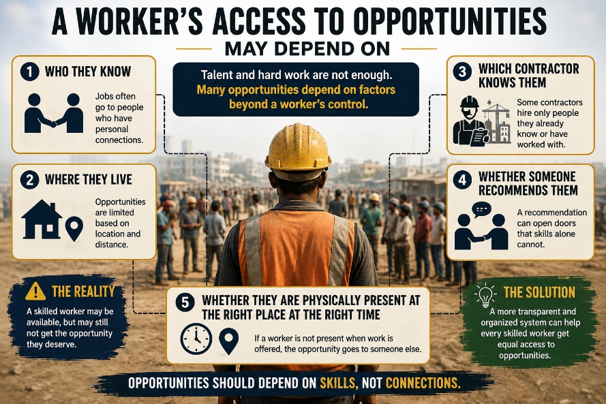
A worker’s access to opportunities may depend on:
- Who they know
- Where they live
- Which contractor knows them
- Whether someone recommends them
- Whether they are physically present at the right place at the right time
This means that a skilled worker may not always be visible to a contractor looking for exactly that skill.
For example, a plumber with ten years of experience may be available for work, while a contractor nearby may simultaneously be searching for a plumber—but the two may never find each other.
This is fundamentally a worker-discovery and matching problem.
3. Wage Uncertainty and Payment Issues
Daily-wage work, by definition, means that construction worker wages vary from day to day. But beyond the natural unpredictability of daily earnings, workers frequently face a lack of clarity around what they will actually be paid, when, and by whom — particularly on sites with multiple layers of subcontracting.Wage uncertainty is another important issue among workers. Together with irregular employment, it remains one of the major challenges faced by construction workers in India.
Payment delays are a recurring concern raised in labour studies and government reviews of the construction sector. Because much of this work happens without written agreements, disputes over wages often come down to a worker’s word against a contractor’s, with little documentation to resolve the disagreement. This report does not have verified, current figures on the average extent of wage delays across India, and it would be misleading to state a specific number without a credible source — but the structural issue of undocumented wage arrangements is well established in official labour reporting.
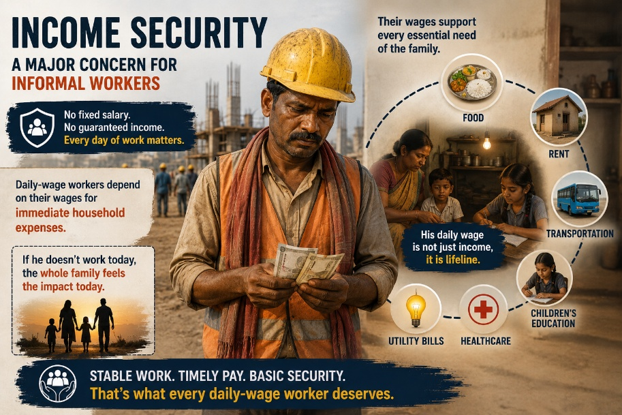
For construction workers, greater transparency around work requirements, wage terms, attendance and payment records can therefore become extremely important
4. Lack of Formal Employment Documentation
Ask a mason with fifteen years of experience how many projects he has worked on, and he can probably name most of them. Ask him to produce documentation proving that experience, and the task becomes far harder.One of the biggest challenges faced by construction workers in India is irregular employment.
Very few daily-wage workers have written contracts, formal appointment letters, or employer-issued experience certificates. Work history exists mostly as memory and word-of-mouth reputation. This creates a genuine problem when a worker tries to access a new opportunity with someone who doesn’t already know them — there is no easy way to prove years of skill and reliability to a stranger.
This gap also affects access to institutional benefits. Banks, insurance providers and some government schemes ask for proof of employment or income that many workers simply cannot produce, even when they have been consistently employed for years.
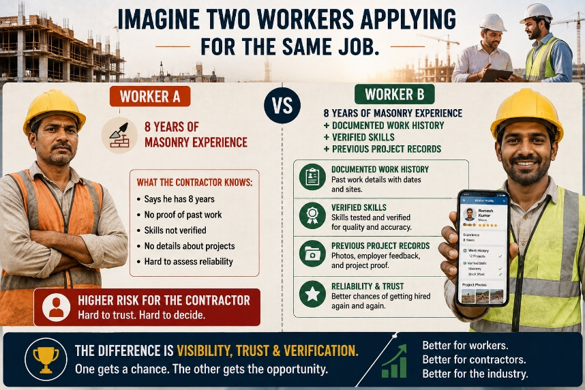
Imagine two workers applying for the same job.
One worker has:
8 years of masonry experience
The other has:
8 years of masonry experience + documented work history + verified skills + previous project records
The second worker has a stronger employment profile because their experience is easier to communicate and verify.
Formalizing information about a worker does not necessarily mean turning every worker into a traditional salaried employee. It can also mean creating better records, visibility and transparency around the worker’s skills and employment history.
5. Migration and Distance From Home
The challenges faced by migrant construction workers are distinct enough to warrant separate attention. A substantial share of India’s construction workforce consists of migrant workers who travel from their home states to cities and towns where construction activity is concentrated. According to NSSOhttps://www.mospi.gov.in/national-sample-survey-office data, interstate migrants account for over a third of all construction workers in urban India. States such as Bihar, Uttar Pradesh, Odisha and Jharkhand are major sources of this migration, while states with large construction and infrastructure activity — including Maharashtra, Delhi and Gujarat — are common destinations.These difficulties add another layer to the challenges faced by construction workers in India, particularly for workers who move between cities for employment.
Migration for work brings its own set of challenges layered on top of the ones already discussed: temporary and often inadequate accommodation near construction sites, added transport costs and time, separation from family for extended periods, and reduced access to local welfare schemes and healthcare in a city where the worker may not be officially registered as a resident.
This should be understood as a structural feature of how construction employment is distributed across India, not as a reflection of poor choices by workers. Migration is, in most cases, a rational response to where the work and the wages actually are.
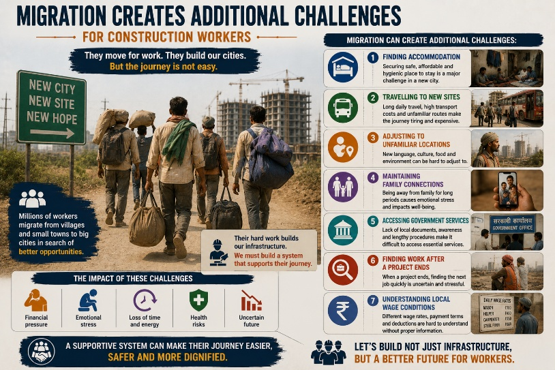
Government initiatives have attempted to improve portability of certain benefits for migrant workers. The Ministry of Labour and Employment for example, notes that eligible workers can access the One Nation One Ration Card system across their native and destination states by the
6. The Worker–Contractor Matching Problem
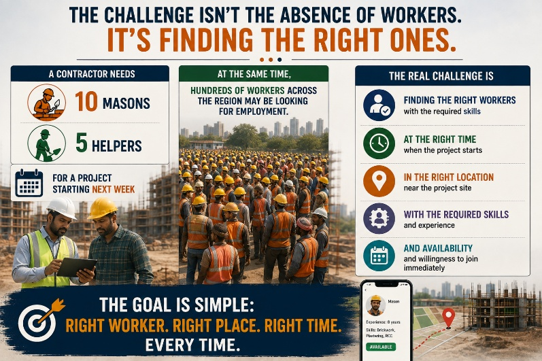
Underlying many of the challenges above is a problem that exists on both sides of the hiring relationship, not just one.
- Workers want: consistent access to relevant construction job opportunities, fair and transparent information about pay and site conditions, work reasonably close to where they live or are staying, and opportunities that match their actual skill level.
- Contractors and site supervisors want: workers with the right skills for the specific job, availability on short notice, reliability, workers located near the project site, and a hiring process that does not consume days of searching.
Both sides are, in effect, dealing with the same underlying issue from opposite ends — an inability to efficiently discover the right match at the right time. This is best understood not as a single problem belonging to workers or contractors alone, but as a workforce discovery and matching problem that the traditional labour chowk system, for all its strengths, was never fully built to solve at scale across a country as large as India.
How Technology Can Help Construction Workers Find Better Opportunities
The question of how technology labour contractors and technologycan help construction workers find jobs is best answered by looking at specific parts of the employment process, rather than treating technology as a single blanket solution. Digital tools cannot rewrite labour law or enforce safety standards on their own. But within their scope, they can meaningfully improve specific parts of the employment process:
- Worker discovery: Making a worker’s availability and skills visible to contractors beyond their immediate personal network.
- Skill-based matching: Connecting job requirements (a mason for three weeks, an electrician for a specific task) with workers who actually have that skill.
- Location-based opportunities: Surfacing nearby jobs so that workers spend less time and money travelling to sites without confirmed work.
- Digital worker profiles: Building a running record of a worker’s trade, experience and site history that travels with them from job to job.
- Employment records: Creating a more consistent paper trail of engagements, which can support future income verification.
- Communication and coordination: Reducing the back-and-forth delay between a contractor’s requirement and a worker’s response.
- Construction workforce management: Helping contractors plan, deploy and track labour across multiple sites more efficiently than manual, phone-and-memory coordination allows.
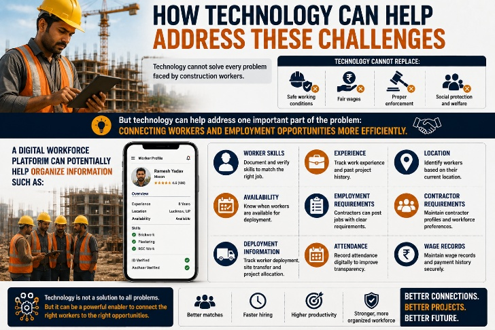
This is particularly relevant as India continues to move toward greater formalization of informal employment. The ILO https://www.ilo.org/ (International Labour Organisation) recent work in India specifically includes efforts to facilitate informal construction workers’ access to jobs, social protection and employment contracts through digital platforms.
How Digital Labour Chowk Is Transforming Construction Labour Hiring
Digital Labour Chowk Digital labour chowk (DLC) is one example of how this discovery-and-matching layer is being addressed in practice. Founded in 2020, DLC operates as a digital version of the traditional labour chowk — a platform where blue-collar construction workers, including masons, electricians, plumbers, carpenters, painters, welders and helpers, can be found and hired by contractors and companies directly, without going through informal middlemen.
The platform is built around two connected applications: one for workers to register their trade, experience and availability, and one for contractors and businesses to post project requirements and search for workers by skill, sub-skill, experience level and location.The platform operates across tier 1, tier 2 and tier 3 cities, extending the reach of digital hiring beyond just India’s largest metros.
It is important to be precise about what this represents: DLC https://digitallabourchowk.com/2026/06/29/digital-labour-platforms/is a workforce discovery and hiring platform. It addresses the matching problem described earlier in this article — helping workers become visible to a wider set of potential employers, and helping contractors find workers who match their specific project requirements more quickly. It does not, and does not claim to, resolve every structural challenge covered in this article on its own. Wage-law enforcement, on-site safety standards, and welfare scheme administration remain the responsibility of government bodies, contractors and the broader policy ecosystem. What a platform like DLC can do is make the employment discovery layer — the part of the process where workers and the right opportunities often fail to find each other — noticeably more organised and efficient than it has traditionally been.
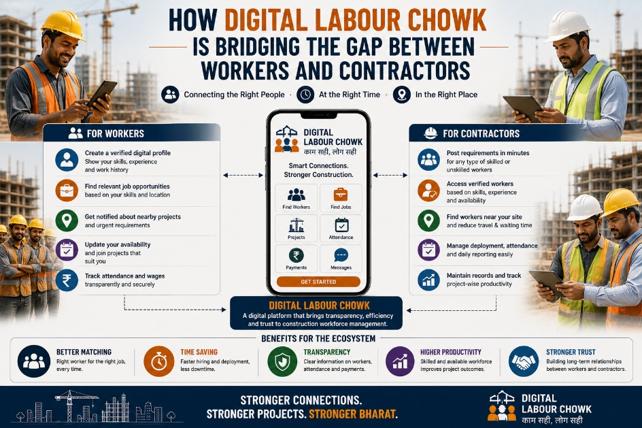
Instead of viewing construction labour simply as a pool of workers waiting for a job, the workforce can be organized around information such as:
Skill + Experience + Location + Availability + Requirement
Conclusion
India’s construction growth is, in the end, a story about people. Every completed flyover, apartment complex and industrial park represents thousands of hours of physical labour performed by workers who often remain invisible in the narrative of the country’s development.
The challenges Faced by labours in India outlined in this article — irregular employment, wage uncertainty, limited documentation, gaps in social security access, safety risks, and the basic difficulty of finding the right job at the right time — are structural, not incidental. They will not be solved by any single reform, scheme or platform acting alone. They require better enforcement of existing worker protections, more responsible practices from contractors, greater awareness among workers themselves, and yes, better technology to close the gap between who needs work and who needs workers.
A country cannot build its future on the labour of people whose own employment future remains uncertain from one day to the next. Fixing that is not charity — it is basic infrastructure for a fair and functioning construction economy.
Frequently Asked Questions
What are the biggest challenges faced by construction workers in India?
The problems faced by daily wage construction workers in India are largely structural rather than individual. The most significant challenges include irregular and project-based employment, wage payment delays, lack of formal documentation of work history, limited access to social security schemes like BOCW despite their existence, workplace safety risks, and the difficulty of being matched with suitable job opportunities, especially for migrant workers.
Why do construction workers often have irregular employment?
Construction work is largely project-based rather than continuous. Once a specific phase of a project (such as foundation work or plastering) is complete, that particular job ends. Seasonal factors like the monsoon and festival travel also affect the availability of work through the year.
How do daily-wage construction workers find jobs?
Understanding how construction workers find jobs in India starts with looking at both traditional and digital hiring channels. Traditionally, workers find jobs through physical labour chowks, personal networks, referrals from other workers, and long-standing relationships with contractors or mistris. In recent years, digital platforms have also started connecting workers directly with contractors and companies based on skill and location.
What challenges do migrant construction workers face?
Interstate migrant construction workers, who make up more than a third of urban construction workers in India according to NSSO data, often face inadequate accommodation, higher living costs at their destination, separation from family, and historically, difficulty accessing welfare benefits registered in their home state. Recent labour code reforms aim to improve portability of these benefits.
How can technology help construction workers find jobs?
Technology can help by making workers’ skills and availability visible to a wider pool of contractors, enabling location-based and skill-based job matching, and creating digital employment records. It cannot, by itself, guarantee fair wages or enforce safety standards — those depend on regulation and enforcement.
What is BOCW?
BOCW BOCW Act refers to the Building and Other Construction Workers (Regulation of Employment and Conditions of Service) Act, 1996, along with the associated Welfare Cess Act. It establishes state-level welfare boards that register eligible construction workers and provide benefits such as accident assistance, maternity aid, education support and pensions, funded by a cess collected on construction costs.
How can digital platforms improve construction labour hiring?
Digital hiring platforms can reduce the time and uncertainty involved in finding work or workers by enabling searchable worker profiles, skill and location-based matching, and direct communication between workers and contractors, reducing dependence on informal, in-person hiring alone.