Book Appointment Now

India’s 4 New Labour Codes Explained Simply
India introduced 4 New Labour Codes to simplify and modernize its labour laws. These new codes replace 29 old labour laws and aim to make rules clearer for employees, employers, and businesses.
In this article, we explain India’s 4 new labour codes in simple language, their purpose, and how they affect workers and employers.
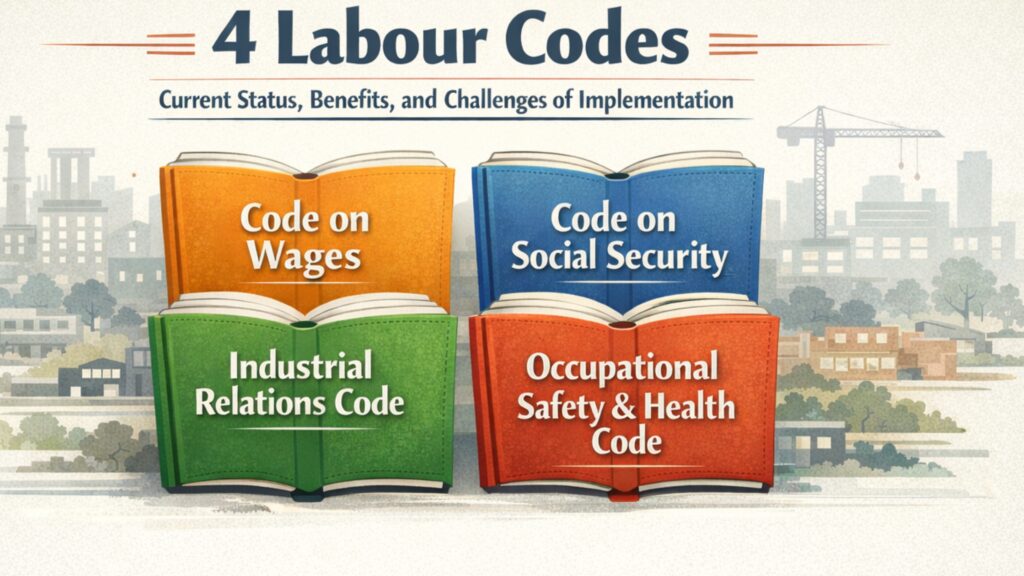
1. Code of Wages (2019)
The Code on Wages, 2019, is the first of India’s four new labour codes. It was introduced to ensure fair wages, timely payment, and equality in remuneration by simplifying multiple wage-related labour laws into one single code.
The main objective of this code is to balance workers’ rights with industrial growth and flexibility.
2. Industrial Relations Code (2020)
The Industrial Relations Code (IRC), 2020, is one of India’s four new labour codes. It replaces multiple old labour laws related to trade unions, industrial disputes, and employment conditions with a single, simplified framework.
The main objective of this code is to balance workers’ rights with industrial growth and flexibility.
3. Code on Social Security (2020)
The Code on Social Security, 2020 is one of India’s four new labour codes. It aims to provide social security benefits to all workers, including organized, unorganized, gig, and platform workers, by consolidating multiple existing labour laws into a single framework.
This code is considered a major step toward universal social security in India.
4. Occupational Safety, Health and Working Conditions Code, 2020
The Occupational Safety, Health and Working Conditions Code, 2020 is one of India’s four new labour codes. It focuses on ensuring safe, healthy, and humane working conditions for workers across various sectors by consolidating multiple labour laws into one comprehensive code.
Why India Replaced 29 Labour Laws with 4 Codes
India replaced 29 central labour laws with 4 Labour Codes to simplify complex regulations, improve worker protection, and promote ease of doing business. This major labour reform aims to modernize India’s labour law framework to suit a fast-growing economy, informal workforce, and gig employment models.
(a) Too Many Labour Laws and Legal Complexity
- 29 central laws + numerous state laws
- Different definitions of wages, worker, employer
- Overlapping provisions created confusion
Result: High litigation and low compliance
(b) Outdated and Colonial-Era Labour Laws
- Many laws were enacted before independence
- Focused mainly on factories and manufacturing
- Did not cover:
- Gig workers
- Platform workers
- Service sector
- Contract employment
(c) Large Informal Workforce
- Over 90% of Indian workers are informal
- Most labour laws applied only to formal sector
- Informal workers lacked:
- Minimum wage protection
- Social security
- Health and safety coverage
(d) Poor Ease of Doing Business
- Multiple registrations and inspections
- Inspector Raj increased corruption
- Employers avoided hiring to escape regulations
Labour reforms aimed to encourage formal employment and investment
Why India Introduced the 4 New Labour Codes
Before the new labour codes, India’s labour laws were considered complex, outdated, and fragmented. Different laws applied to different sectors, which created confusion for employers and limited protection for many workers, especially in the unorganized sector.
Some major problems with the old system included:
- Too many laws with overlapping provisions
- Difficult compliance for businesses
- Limited social security coverage
- Exclusion of gig and informal workers
To address these issues, the government introduced the four labour codes with the objective of:
- Simplifying labour laws
- Improving ease of doing business
- Expanding worker coverage
- Ensuring fair wages and safe working conditions
These reforms aim to create a balanced labour ecosystem that supports economic growth while safeguarding workers’ interests.
Key Changes from Old Labour Laws to New Codes
The new labour codes introduce several important changes compared to the old laws.
- Simplification of Laws
Instead of 29 separate acts, there are now 4 comprehensive codes, making compliance easier for employers and understanding simpler for workers.
- Uniform Definition of Wages
The Code on Wages introduces a standard definition of wages, reducing salary manipulation through excessive allowances and improving PF and gratuity benefits.
- Hire-and-Fire Threshold Increased
Under the Industrial Relations Code, establishments with up to 300 workers can retrench employees without prior government approval (the earlier limit was 100).
- Recognition of Gig and Platform Workers
The Social Security Code legally recognizes gig and platform workers and mandates aggregator companies to contribute to their welfare funds.
- One Registration, One License
The OSH Code introduces a single registration and licensing system, reducing paperwork and regulatory burden.
- Women Empowerment Provisions
Women are now allowed to work night shifts, provided safety and consent conditions are met.
Impact of the New Labour Codes on Employees and Employers
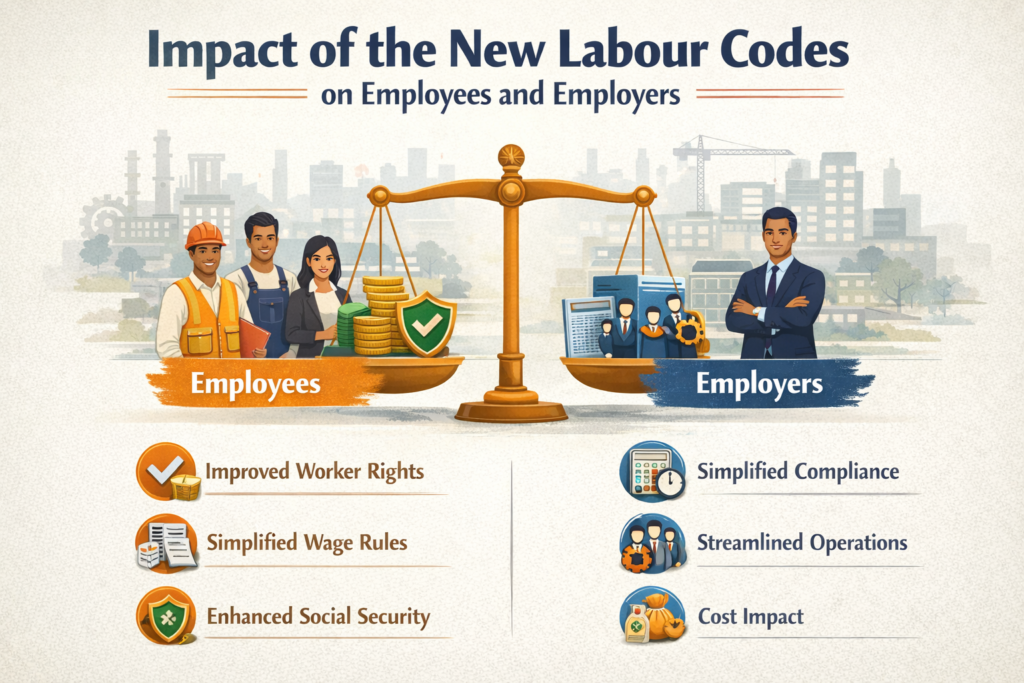
Impact on Employees
Positive impacts:
- Guaranteed minimum wages
- Timely payment of salaries
- Improved PF and gratuity benefits
- Social security for gig and informal workers
- Safer working conditions
Concerns:
- Increased flexibility in retrenchment may affect job security
- Stricter rules on strikes may limit collective bargaining
Impact on Employers
Positive impacts:
- Simplified labour compliance
- Reduced legal complexity
- Flexibility in workforce management
- Digital inspections and registrations
Challenges:
- Higher wage and social security costs
- Need to restructure salary components
- Initial compliance adjustments
Overall, the codes aim to create a win-win framework, but their success depends on fair enforcement.
Current Status, Benefits, and Challenges of Implementation
Current Status of Implementation
Although the labour codes have been passed by Parliament, their implementation depends on state governments framing rules. As a result:
- Some states have notified rules
- Many states are still in the process
- Nationwide implementation remains uneven
Benefits of the New Labour Codes
- Simplified legal framework
- Wider worker protection
- Formal recognition of gig workers
- Improved ease of doing business
- Better safety and health standards
Challenges and Criticism
- Delay in state-level implementation
- Concerns raised by trade unions
- Awareness gaps among workers
- Enforcement difficulties in unorganized sectors
Conclusion
India’s 4 New Labour Codes represent one of the biggest labour law reforms in the country’s history. By replacing 29 outdated laws with 4 modern codes, the government aims to create a system that supports economic growth, worker welfare, and legal clarity.


[…] April 2026, India is introducing revised minimum wage rates under the Minimum Wage Hike 2026, aimed at improving income security for workers and reducing wage inequality across […]