Book Appointment Now

Civil Engineers: Why India Needs More Skilled Professionals Than Ever Before
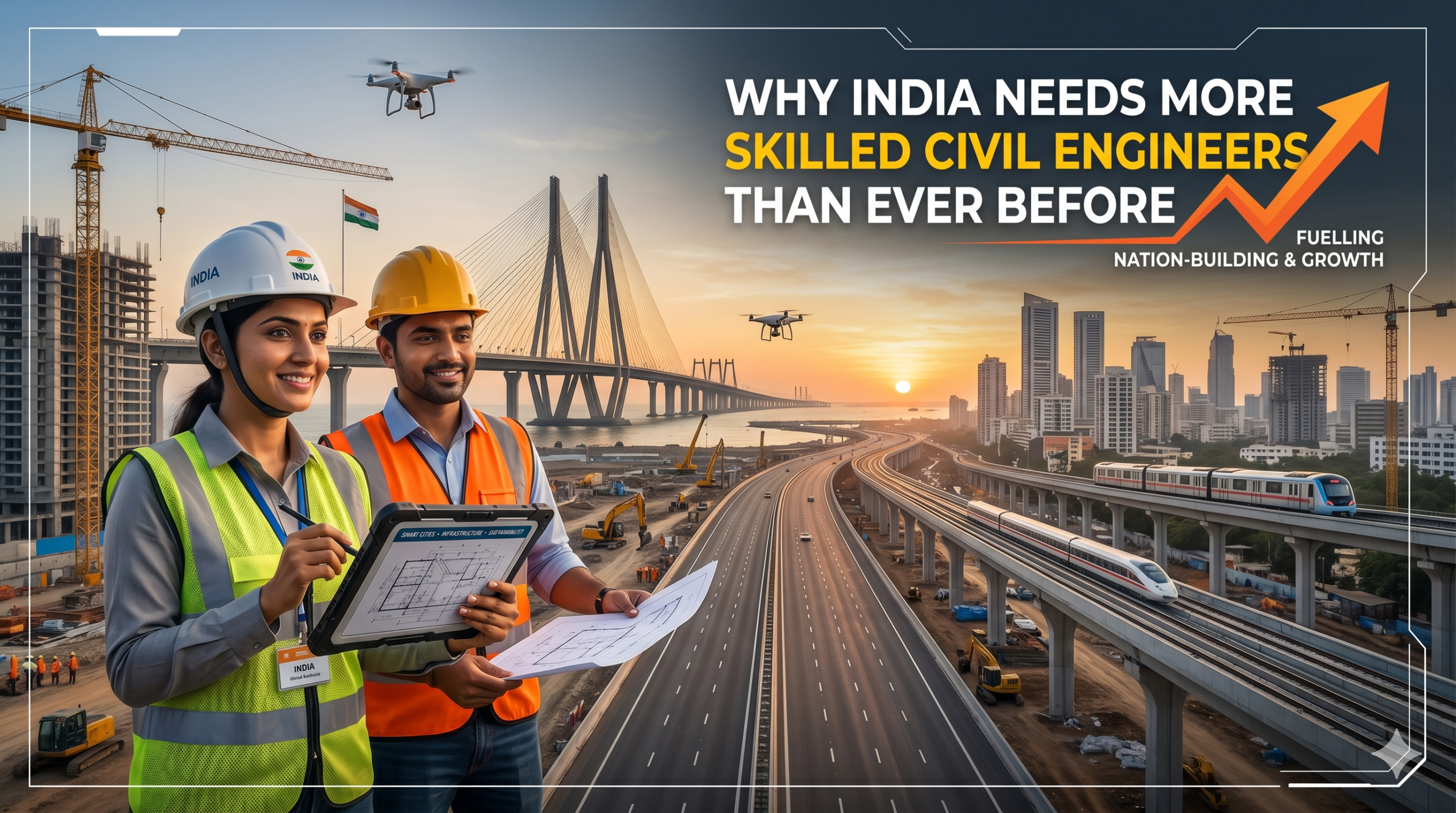
India is building faster than ever before. New highways, smart cities, metro projects, bridges, housing societies, and industrial zones are growing across the country. But despite massive development, the construction industry is facing a serious challenge — a shortage of skilled civil engineers.
This problem is not about the number of engineers graduating every year. The real issue is skill readiness.
Let’s understand why this gap exists and how it can be solved.
The Growing Demand in Construction
Construction is one of India’s largest employment sectors. From small residential projects to large infrastructure developments, civil engineers play a crucial role in planning, execution, safety, and quality control.
Today, companies are actively hiring:
- Site Engineers
- Project Engineers
- Planning Engineers
- Quantity Surveyors
- Construction Supervisors
However, many employers say fresh graduates lack practical knowledge. This creates a skill gap in civil engineering that slows project efficiency.
Why Is There a Skill Gap?
1. Too Much Theory, Less Practical Exposure
Many engineering students learn formulas, design concepts, and software in classrooms but get limited real construction site exposure.
Construction sites demand:
- Problem-solving skills
- Material knowledge
- Team coordination
- On-site decision making
Without hands-on learning, graduates struggle when they enter real projects.
2. Limited Industry–Academia Connection
Colleges and construction companies often work separately instead of collaboratively.
Students rarely experience:
- Live construction projects
- Internship-based learning
- Industry mentorship
Stronger collaboration can reduce the skill gap in civil engineering significantly.
3. Rapid Infrastructure Growth
India’s infrastructure development is expanding faster than the workforce can adapt.
Projects such as:
- Highways
- Rail corridors
- Smart cities
- Commercial buildings
require engineers who can start contributing immediately. Companies cannot afford long training periods.
What Makes a Civil Engineer Truly Skilled?
A skilled civil engineer is not defined only by a degree. The industry values engineers who continuously learn and improve.
Key skills include:
✅ Site supervision
✅ Reading construction drawings
✅ Quantity estimation
✅ Safety management
✅ Communication with workers and contractors
✅ Cost and time management
Engineers who observe, question, and measure their daily work become indispensable professionals.
The Importance of Upskilling
Upskilling is no longer optional — it is essential.
Civil engineers should focus on:
- Practical internships
- Learning construction technology
- Understanding materials and equipment
- Digital tools and project management software
- Field-based learning
Continuous learning directly reduces the skill gap in civil engineering and improves career growth.
How Digital Platforms Are Changing Hiring
Earlier, engineers and workers depended on local labour chowks or personal references for jobs. Today, digital platforms are transforming hiring in construction.
Modern hiring platforms help companies:
- Find verified engineers quickly
- Check experience and skills
- Reduce hiring delays
- Improve workforce productivity
Digital hiring systems also help engineers discover better opportunities based on their skills.
Technology is becoming a powerful solution to the skill gap in civil engineering.
Role of Companies and Institutions
Solving the problem requires joint effort.
Educational Institutions Should:
- Introduce site training from early semesters
- Focus on practical labs and live projects
- Invite industry experts regularly
Construction Companies Should:
- Provide structured internships
- Train fresh engineers on-site
- Encourage mentorship programs
When education and industry work together, the skill gap in civil engineering can be reduced faster.
Advice for Future Civil Engineers
If you are a student or young engineer, remember:
👉 Do not wait for opportunities — build skills daily.
👉 Spend time on construction sites.
👉 Learn from senior engineers and workers.
👉 Ask questions and analyze problems.
Engineers who continuously improve their practical knowledge never struggle to find work.
The Future of Civil Engineering in India
India’s construction future is extremely strong. Infrastructure investment is increasing, urbanization is accelerating, and skilled professionals will remain in high demand.
The engineers who succeed will be those who combine:
- Technical education
- Practical experience
- Digital adaptability
- Continuous learning
Closing the skill gap in civil engineering is not just an industry need — it is the foundation of India’s development.
Conclusion
India does not lack civil engineers. It lacks industry-ready civil engineers.
The solution lies in practical learning, upskilling, and smarter hiring systems. When engineers focus on real-world skills and companies support training initiatives, the construction sector becomes stronger, faster, and more efficient.
The future belongs to professionals who learn every day and make themselves indispensable.