Book Appointment Now

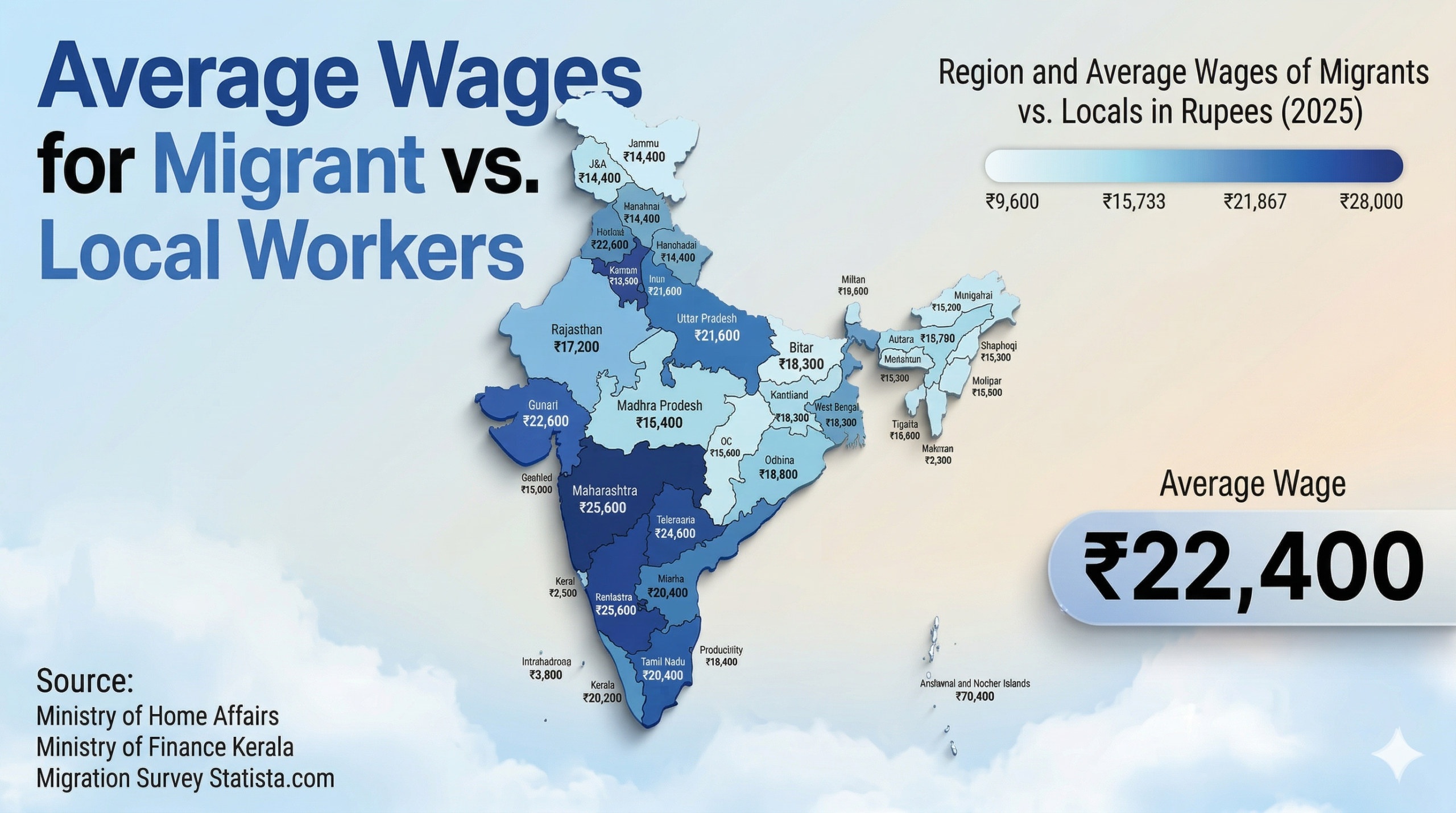
Migrants vs Local Workers Wages: What the Numbers Actually Tells Us
- On
- InGuide
Most people see wage data as just a labour statistic.
But in reality, wages reveal something deeper about how economies, cities, and businesses function.
Across India, wage differences between migrant workers and local workers are not random. They reflect labour demand, migration patterns, skills, and business strategy decisions.
Understanding average wages for migrants vs local workers helps organisations make smarter hiring, planning, and operational decisions.
Why Wage Differences Exist
Wages are shaped by how labour markets operate.
When industries grow in a particular region, they attract workers from other states. This movement changes the balance between labour supply and labour demand.
In many industrial and urban areas, migrant workers fill labour shortages quickly. Because of this, the average wages for migrants vs local workers often show noticeable differences.
Local workers may negotiate higher wages due to familiarity with local markets, while migrants may accept varied wage structures depending on opportunity and urgency.
Labour Availability vs Demand Concentration
Regions with strong industrial activity — construction hubs, manufacturing clusters, logistics zones, and healthcare centres — require continuous manpower.
When local labour supply is limited, migrants become essential to operations.
Businesses depend heavily on migrant labour to maintain productivity. As a result, analysing average wages for migrants vs local workers becomes important for understanding operational dependency on labour.
High-demand regions usually show:
- Faster hiring cycles
- Higher workforce mobility
- Competitive wage adjustments
Wages, therefore, reflect economic activity more than individual negotiations.
Migration and Workforce Dynamics
Migration plays a central role in India’s workforce structure.
Workers often migrate from low-income regions to cities offering better opportunities. This migration increases labour availability but can also create pressure on wages and working conditions.
The average wages for migrants vs local workers often vary because migrants prioritise employment stability, while locals may prioritise long-term earning growth.
For businesses, migrant labour provides flexibility, while local labour provides continuity and institutional knowledge.
Both groups contribute differently to workforce stability.
Cost of Living and Urbanisation
Urbanisation directly impacts wages.
Cities with higher living costs naturally push wages upward. Industrial zones demand higher productivity, better skills, and faster work cycles.
This is why metropolitan areas typically report higher average wages for migrants vs local workers compared to rural regions.
Higher wages are not only compensation for work — they compensate for:
- Housing expenses
- Transportation costs
- Urban lifestyle pressures
- Productivity expectations
Wage levels therefore mirror the economic intensity of a location.
Skill Distribution Across Regions
Skill availability strongly influences wage differences.
Regions with skilled labour pools command higher wages because specialised work increases productivity.
Local workers sometimes hold advantages due to language familiarity, networks, and long-term experience. Migrant workers, on the other hand, often bring adaptability and willingness to work across roles.
When analysing average wages for migrants vs local workers, higher wages frequently correlate with specialised skills rather than worker origin.
Skill demand ultimately drives wage growth.
What Businesses Should Understand
From a business perspective, wages are not just expenses on payroll sheets.
They reveal deeper organisational realities.
The average wages for migrants vs local workers indicate:
- Operational dependency on human labour
- Efficiency of internal processes
- Location-based strategy choices
- Workforce planning maturity
Companies that treat labour purely as a cost often struggle with turnover, delays, and inconsistent productivity.
Successful organisations design workforce systems instead of reacting to labour shortages.
Labour Cost Is Designed, Not Managed
In sectors like healthcare, manufacturing, construction, and services, labour structures determine long-term profitability.
Businesses that understand wage patterns build structured hiring systems, predictable workforce pipelines, and stable operations.
When companies analyse average wages for migrants vs local workers, they gain insight into how efficiently their operations function.
Over time:
- Inefficiency appears as rising labour costs.
- Strong structure appears as improved margins.
Wages therefore become a strategic indicator, not just a financial metric.
The Bigger Economic Signal
Wage data tells the story of economic movement.
Migration shows where opportunities exist.
Higher wages show where productivity grows.
Workforce flows show where industries expand.
Understanding average wages for migrants vs local workers helps policymakers, employers, and workforce platforms make better decisions about hiring, training, and regional development.
In the long run, economies grow not simply by increasing wages, but by designing systems that balance labour demand, skills, and opportunity.
Conclusion
The difference between migrant and local wages is not about competition between workers.
It is about how labour markets evolve.
Wages reflect workforce mobility, industrial growth, skill distribution, and business strategy. Organisations that study average wages for migrants vs local workers move from reactive hiring to strategic workforce planning.
Because ultimately, wages are not just numbers.
They represent how efficiently businesses operate and how intelligently economies grow.
Newsletter Updates
Enter your email address below and subscribe to our newsletter