Book Appointment Now


Labour Contractors and Technology: 1 Threat or 1 Wake-Up Call?
For decades, labour contractors have played a critical role in India’s construction, infrastructure, manufacturing, and services sectors. They have connected workers to jobs, managed manpower on sites, and kept projects moving—often under difficult conditions.
Today, however, the relationship between labour contractors and technology is reshaping how work is hired, managed, and paid.
Mobile apps, digital platforms, and data-driven hiring tools are entering a space that has traditionally been informal and relationship-based. This has raised an important question:
Is technology replacing labour contractors—or pushing them to evolve?
The answer is not as simple as “yes” or “no.”
The Traditional Role of Labour Contractors
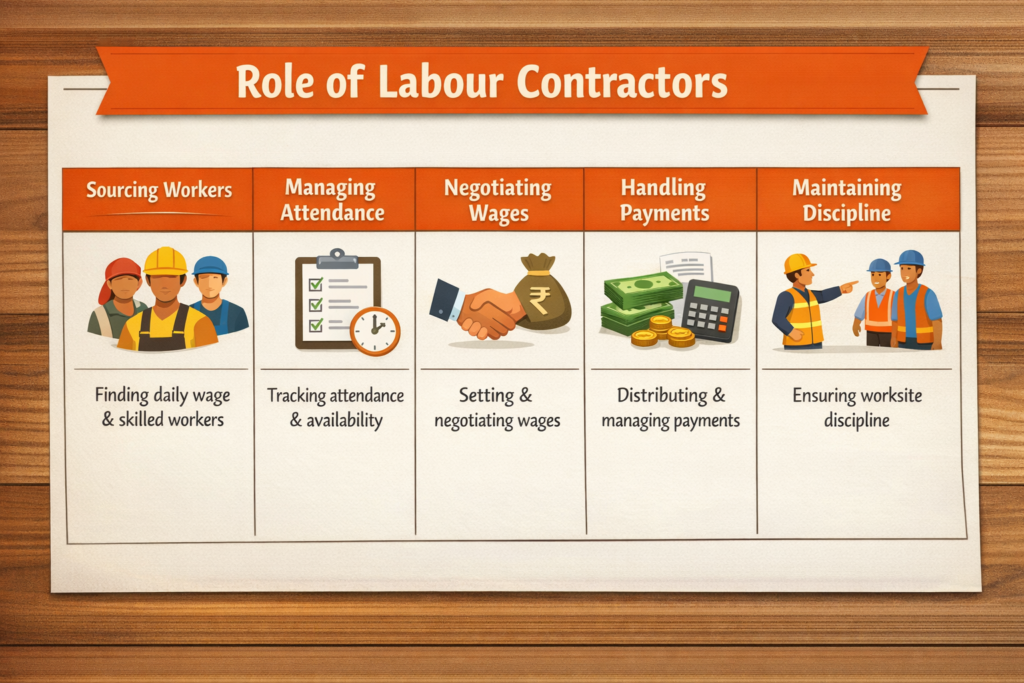
Labour contractors have long acted as the bridge between workers and employers. Their responsibilities typically include:
- Sourcing daily wage or skilled workers
- Managing attendance and availability
- Negotiating wages
- Handling payments
- Maintaining discipline on site
In an unorganised labour market, contractors effectively became the system. They filled gaps where formal hiring, documentation, and workforce management did not exist.
Over time, however, this system also developed limitations.
Challenges in the Current Contractor Model
While labour contractors remain essential, the traditional model is under increasing pressure. Some of the key challenges include:
1. Lack of Transparency
Hiring, wage agreements, and payments are often verbal. This creates confusion and frequent disputes for both workers and employers.
2. Dependence on Middlemen
Multiple layers between contractors and workers can reduce earnings for labourers while increasing costs for employers.
3. No Worker Records
Skill levels, work history, and reliability are rarely documented, making long-term workforce planning difficult.
4. Scaling Issues
As projects grow larger and timelines tighten, manual coordination becomes inefficient and risky.
These challenges are not always intentional—but they are real.
How Labour Contractors and Technology Are Coming Together
Technology in labour hiring does not mean machines replacing workers. Instead, it means systems replacing inefficiencies.
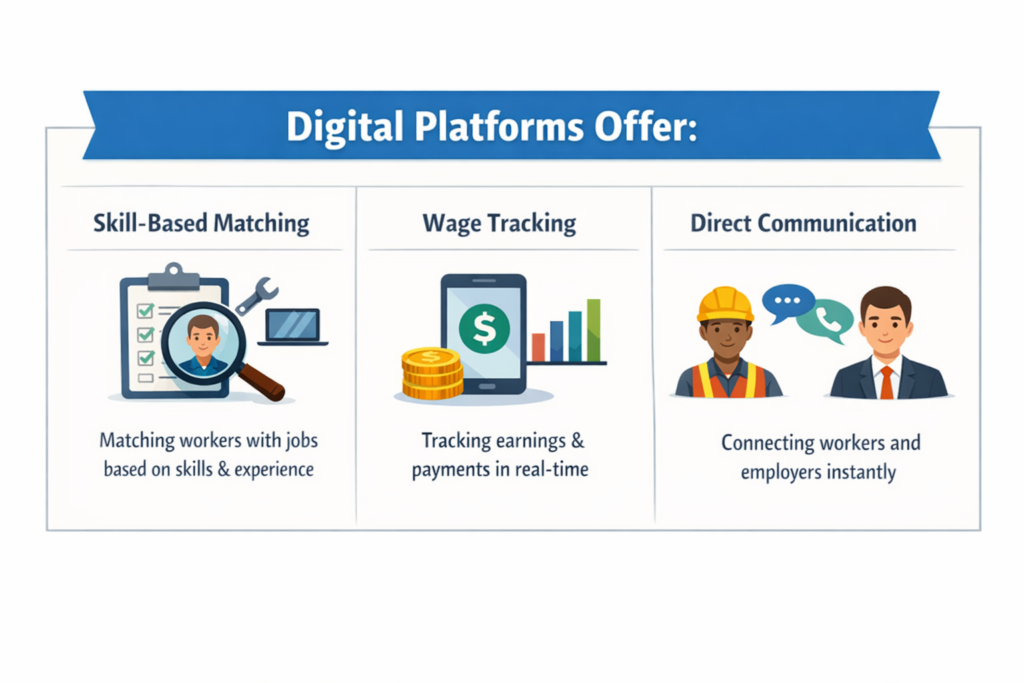
Today, digital platforms offer:
- Skill-based matching
- wage tracking
- Direct communication between workers and employers
This shift is changing expectations across the industry and redefining the relationship between labour contractors and technology.
Why Contractors Feel Threatened by Technology
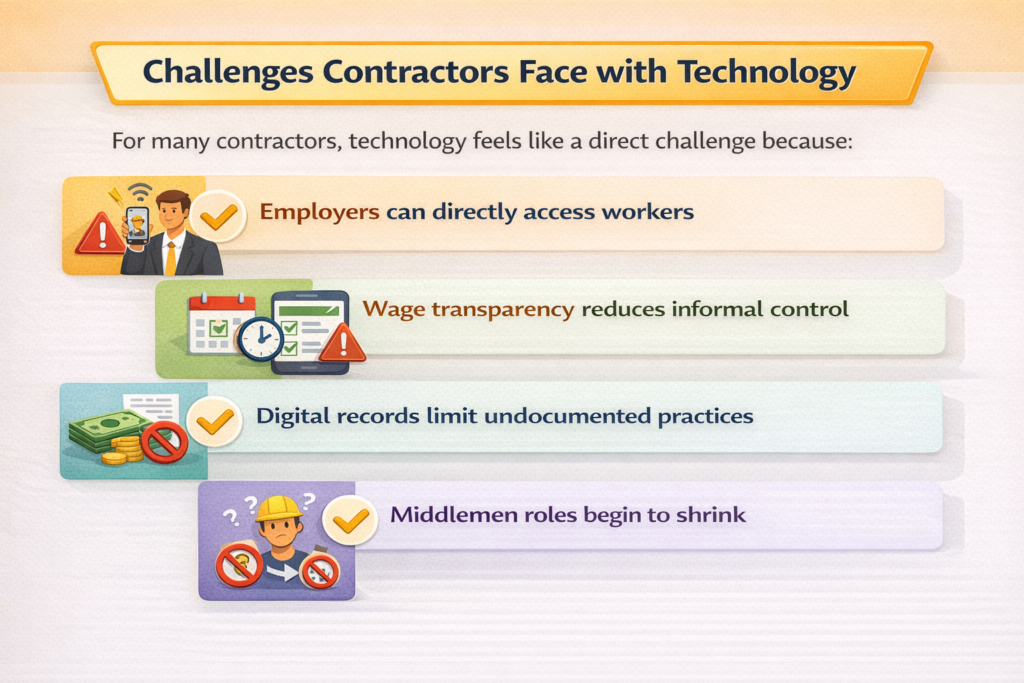
For many contractors, technology feels like a direct challenge because:
- Employers can directly access workers
- Wage transparency reduces informal control
- Digital records limit undocumented practices
- Middlemen roles begin to shrink
This concern is understandable. Any system change feels risky—especially when livelihoods are involved.
However, history shows that technology rarely removes roles entirely. It reshapes them.
Labour Contractors and Technology: A Redefined Role
The real impact of technology is not elimination, but evolution.
Contractors who adapt can move from being simple manpower suppliers to professional workforce managers.
The role is shifting:
- From middleman → operations partner
- From verbal coordination → data-backed planning
- From daily uncertainty → predictable workforce supply
Instead of spending hours at labour chowks, contractors can focus on:
- Managing multiple sites efficiently
- Ensuring skilled labour availability
- Maintaining compliance and safety standards
- Building long-term relationships with workers
In this model, technology handles administration, while contractors handle execution and human judgement.
Benefits for Contractors Who Embrace Technology
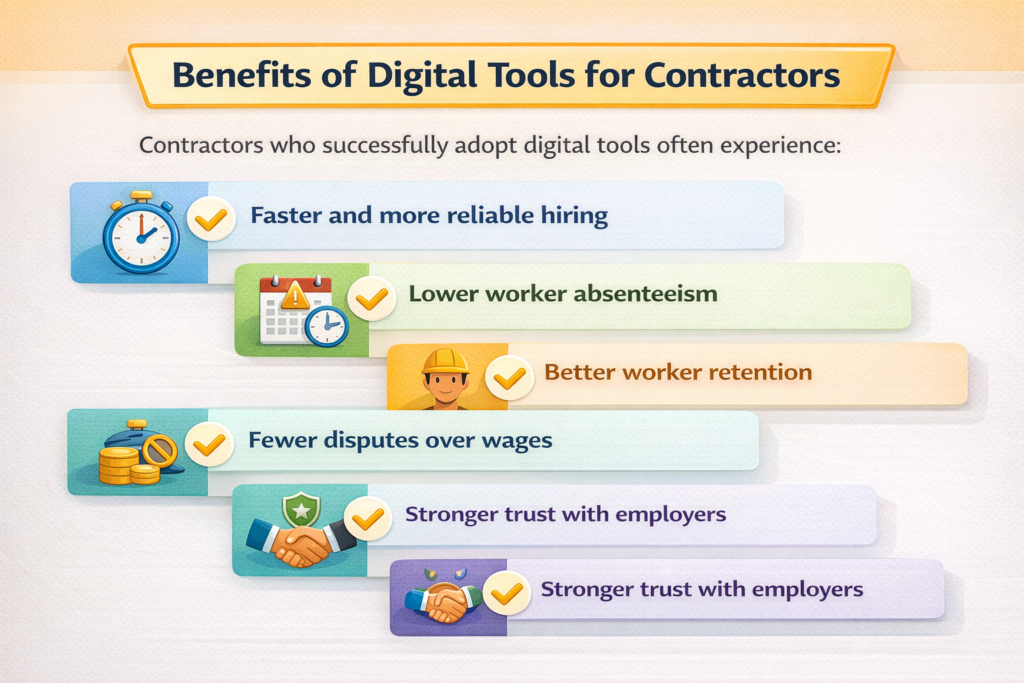
Contractors who successfully adopt digital tools often experience:
- Faster and more reliable hiring
- Lower worker absenteeism
- Better worker retention
- Fewer disputes over wages
- Stronger trust with employers
Most importantly, they become future-ready.
As regulations tighten and clients demand transparency, the use of technology will no longer be optional—it will be expected.
A Wake-Up Call, Not a Threat
Technology is not here to destroy the labour contractor ecosystem.
It is highlighting what no longer works.
The real threat is not labour contractors and technology working together.
The real threat is refusing to change.
Contractors who continue with informal, undocumented, and inefficient systems may struggle. Those who upgrade their methods will remain essential—just in a more structured and respected role.
The Future Is a Hybrid Model

The future of labour hiring will not be fully digital or fully traditional.
It will be a hybrid system, where:
- Technology provides structure and visibility
- Contractors provide ground-level execution and trust
- Workers gain dignity, predictability, and access to better opportunities
This balance is where sustainable progress lies.
Final Thoughts
Technology is not asking labour contractors to disappear.
It is asking them to level up.
Those who see the shift in labour contractors and technology as a wake-up call—rather than a threat—will not only survive, but lead the next phase of India’s labour ecosystem.
Change is uncomfortable.
But stagnation is far more dangerous.